Using Your Toes in Tree Pose
To use your toes in tree pose, trying shifting your weight forwards so that your toes naturally press down into the floor. If you find your inner toes (big toe etc) press down with greater pressure than your outer toes, try rotating your leg outwards relative to your foot. If you find your outer toes press down with greater pressure you can try rotation your leg inwards relative to your foot.
Activating Your Ankles and Stabilizing Your Feet
Prior to pressing your toes down, you may find it helps to activate your ankle and foot so that the bones of your foot and ankle support each other.
Simply put, try making your foot and ankle feel strong.
Getting Into Tree
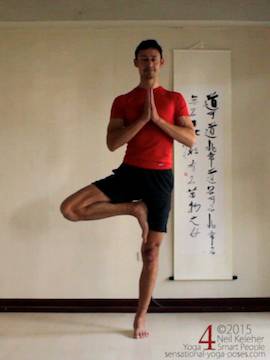
In Tree Pose (Vrksasana) you stand on one foot with the other foot resting high up on the inner thigh of your standing leg.
So that you open the hip of your lifted leg, try actively pressing your foot against into your inner thigh. Activate your foot in the same way you activated the standing foot and press the inner thigh with both your heel and forefoot. You'll probably notice that your knee moves further back as a result. You may also notice that your hip joint seems to "open."
Positioning Your Foot
To position your lifted foot against your inner thigh you'll probably have to use your hand to help. If you can't keep your foot in place then use your hand to help keep it in place. If you have to bend forwards to do this, try using a strap or long towel to extend your reach. (Wrap the towel around your ankle and hold the towel in such a way that you can stand upright. A face towel or flannel probably won't cut it.)
Remember:
Use Your Toes To Balance
Drill Your Leg Into the Ground
So that your tree grows upwards and roots down at the same time press your standing foot into the floor.
The feeling is like you are trying to drill your leg downwards. To that end it may help to focus on pressing your forefoot and/or your heel. You may be able to feel the bones of thigh and lower leg in one straight line pressing downwards.
As you drill you leg downwards may feel like your pelvis then presses upwards.
Reach Up, Away From Your Pelvis
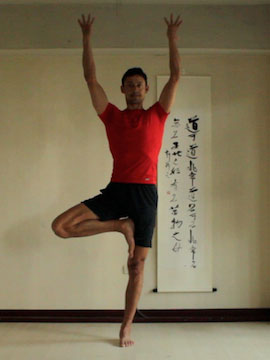
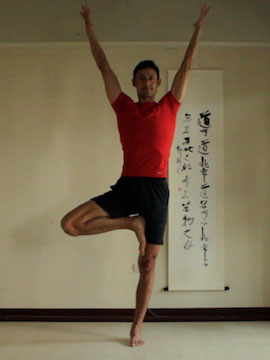
To expand the rest of your body upwards in tree pose, reach your ribs up away from your pelvis and your head up away from your ribcage. Lengthen your spinal column upwards.
At the same time spread your shoulderblades (move your shoulders forwards) and reach your arms forwards and then up towards the sky.
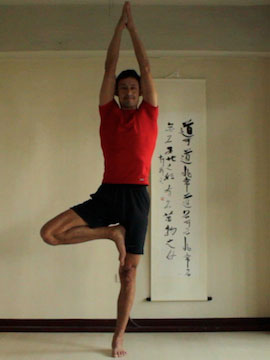
Arms Up and Relaxed, Then Up and Reaching up, then arms up and palms together.
So that your pose breathes, reach up as you inhale and then relax as you exhale.
Start with your hands apart and then work at touching them together while keeping your elbows straight. This may be easier to do if you focus on moving your shoulder blades forwards, towards the front of your chest. You can move your shoulder sockets up (towards your ears) but at the same time pull down on the inner edges of your shoulder blades.
Difficulty Balancing in Tree Pose? Activate Your Feet
If you have week feet or ankles, or have difficulty controlling them, you can practice activating your feet while standing on both feet.
(For more details on activating your feet, check out the "Balancing on one foot" section)
From there, you can try pressing the inner thigh of your standing leg backwards while keeping your knee pointing straight ahead. You may find that this action helps to make your standing leg more stable.
Do this while pressing foot into your inner thigh. (And press with the front of the foot and the heel.)
You can also work on resisting the foor pressure with the inner thigh of your standing leg. So as you press your foot into your inner thigh, press your inner thigh against your foot.
One Side Is Better than the Other!
If you find that it is easier to do tree pose on one side versus the other, you can try some of the preparation positions included in yoga tree pose.
Practice Keeping Your Spine Vertical
With your foot active, your next challenge may be that of keeping your spine vertical. By that I mean that your ribcage and head are both stacked on top of your pelvis.You may find that it is to do this if you watch yourself in a mirror.
To make (or keep) your spine vertical, move both your pelvis and your ribcage (and head) over the foot you are going to balance on. If you are balancing on your right foot then move the center of your pelvis and ribcage over your right foot.
Practice moving from one foot to the other while watching yourself in the mirror. Is your spine upright? If not what changes do you need to make so that it is upright?
Another way to practice keeping your spine vertical while balancing on one foot is to stand sideways next to a wall with your arm down by your side. Stand close enough that you can get your weight onto the foot closest to the wall and touch your shoulder to the wall at the same time.
Keeping your arm by your side practice moving your ribcage and pelvis together so that your shoulder, elbow and hand touch the wall and the same time.
Weight Shifting from Front to Back
So that you can get used to controlling your center while in tree pose, you can practice shifting your weight forwards and backwards while balancing on both feet.
With your feet active, move your body forwards so that all of your weight is evenly on the fronts of your feet. In this position the fronts of your feet and toes should press down with equal pressure.
- Balance here and keep your weight in the same place.
- Your heels should be able to easily lift off of the floor.
Now shift your weight so that it is over your heels. Allow the fronts of your feet to lift.
See how long you can balance in either position.
Use Your Toes to Help You Balance
You probably noticed that it was easier to balance with your weight over the fronts of your feet. That's because you could use your toes to help control your balance. Ideally you'll learn to balance easily on the fronts of your feet and on your heels but for now, you can practice balancing on one foot with your weight forwards. Use your toes to help you balance!
Your weight doesn't have to be all the way forwards, just forwards enough that your toes naturally press the floor. So, with both feet on the ground and your weight centered between them shift your weight forwards enough that your toes press into the floor. Remember to activate your feet first!
Now shift your weight onto your right foot. Feel the inner and outer edges of your right foot pressing down with equal pressure. Lift your left foot and balance.
Try the same thing on the other foot.
Switch back to your original foot and place your lifted foot against your inner thigh in tree pose. If you need to use your hand to help. Press your inner thigh with your heel and with your forefoot. Feel your knee reaching to the side and your hip joint opening.
If you can't get your foot up to your inner thigh then place it lower on your leg. Gradually work at lifting it higher.
Keep your center of gravity over your standing foot.
Stay aware of your standing foot and lengthen your tree pose upwards.
Smoothly and gradually lift your ribs up and away from your pelvis. Move your shoulders forwards so that your shoulder blades spread. Then reach your arms forwards and up so that your shoulder blades stay spread. Touch your hands together.
As an option you can also place your hands in front of your heart.
Can you do this with your eyes closed?
Variations of Tree Pose
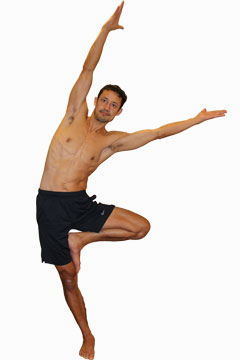
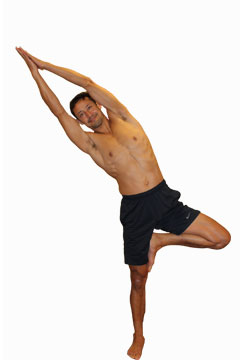
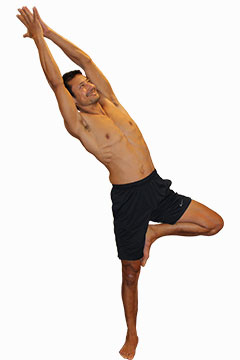
To make tree pose more interesting, or more of a challenge you can try bending to one side or the other side. You can also try twisting your ribcage. And you can try side bending and twisting your ribcage at the same time.
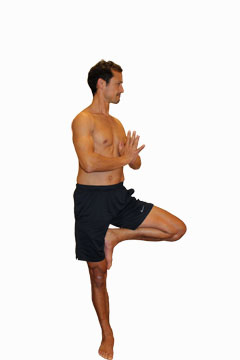
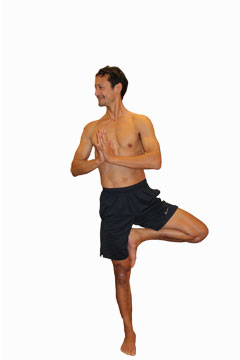
Vrksasana while bending to either side (1 and 2) and while twisting (3 and 4) and while twisting and bending (5).
To do tree pose while bending to one side, you can bend first to the side of your lifted leg. So that you stay balanced in tree pose, if your hips move left then your ribcage head and arms will have to move to the right.
As you bend to the side stay aware of your foot and use it to tell you when your weight is shifting away from center. Correct it if it does.
You may find that bending to the lifted leg side is easier because this actually helps you to press your foot into your thigh. Try bending away from the lifted leg also.
To do tree pose while twisting you can turn and twist your ribcage either towards your lifted knee or away from it.
Focus on turning your ribs relative to your pelvis and also focus on twisting your thoracic spine.
Because you are standing on only one foot it can be a little bit more difficult to keep your pelvis square to the front while twisting.
Feel each vertebrae turning relative to the one below it.
You can also combine a twist with a side bend in yoga tree pose. While bending you can turn your ribcage so that your chest faces upwards or so that it faces downwards. As before, you can bend towards your lifted knee or away from it.
Published: 2011 01 17