Meridian Stretches for the Inner Thighs
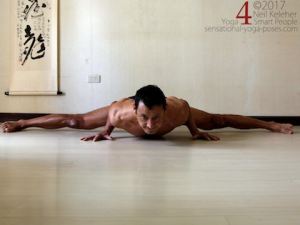
Stretches for the inner thighs include butterfly pose, frog pose, half split, full split and half moon. Note that there are at least two yoga poses called frog pose (bekasana.) This is not the same as the version found in the Ashtanga second series.
Butterfly (bound angle) yoga pose
In butterfly yoga pose sit with your feet together and with your knees bent and open to the sides. Sit with you heels close to your pelvis. To begin with, sit up tall with your hands on the floor behind your. Lift your chest and lengthen your neck.
The usual instruction for this pose is to push your knees down. Instead of pushing your knees down, focus on using your leg muscles to push the sides of your feet into the floor. You may find that your knees press down anyway. Perhaps more importantly, you may also find that it feels more comfortable and that it opens your hips faster.
For a slightly different meridian stretch, grab on to the outsides of your feet, and bend forwards while continuing to press your feet into the floor. Or reach your arms forwards and use the weight of your arms to help tilt your pelvis forwards.
Frog Pose
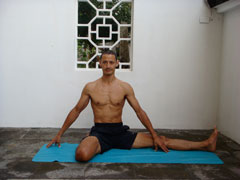
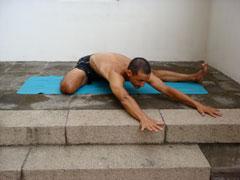
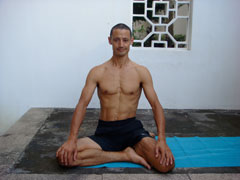
For frog pose, open your legs to 90 degrees. Bend one knee and fold the shin outside the thigh. Turn so that your thighs are both open to 45 degrees either side of your center line. (Picture 2.) From here, reach your hands forwards and tilt your pelvis forwards. Focus on relaxing your hip joints.
If the back of your legs are really tight, sit on a block or some books. You can also try bending the straight leg knee.
Use your arms to help support the weight of your ribcage. Lower your ribcage slowly.
Work at keeping your spine long. Also work at creating space in your hip joints by reaching your knees away from your pelvis.
Half Split
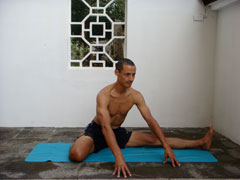
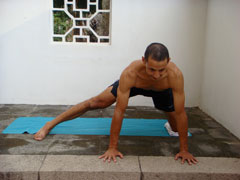
For the "half split" meridian stretch, bend one knee and place it on the floor. You might want to place a towel beneath it to make your knee more comfortable.
Straighten your other knee and reach that leg out to the side. Position the heel of your straight leg on the same horizontal line as your bent leg knee. Position your pelvis so that it is in line with your straight leg and bend knee.
Have your hands on the floor.
Slowly move your foot away from your knees. As you do so move your hands in the same direction so that your spine stays positioned at ninety degrees to your straight leg.
So that you can widen your legs focus on relaxing your inner thighs. See what happens when you activate your feet and when you keep them relaxed. You can also experiment with activating your outer glutes (the side hip muscles) and relaxing them.
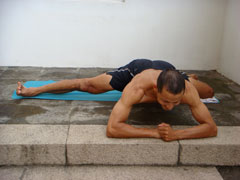
You can either lay down on your belly and then relax to come out of the pose or you can slowly walk your thighs towards each other.
Once you are reasonably comfortable with this pose you can start of with your elbows straight and your spine bent backwards.
Activate your spinal erectors to make this an active back bend.
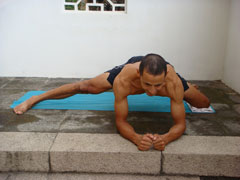
After a few minutes... okay after about one minute, or when you think you are as low as you can go in this position, bend your elbows and lower your chest to the floor. (If you chest won't reach the floor then use some blocks. Rest your chest on the blocks instead.)
Use your arms to slowly lift your chest and then slowly lower to the floor and relax. Then repeat. Each time you lift your chest you may notice that you are adding weight to the pose. As a result you use your body weight to help deepen the stretch. Each time you place your chest on the floor you can relax.
If your chest is on blocks, you can do the same thing, slowly lift your chest and lower it. You may notice that you can slowly reduce the height of the blocks that you are using as your inner thighs lengthen and as your legs move further apart.
Full Splits
If doing full splits, you can apply a similar technique.
First of all start with your arms straight. Sink your pelvis and actively bend your spine backwards. When you are as deep as you can go, bend your elbows and rest your chest on the floor or on blocks. Lift and lower your chest using your arms. If you are using blocks, gradually reduce the height of the blocks as your inner thighs lengthen.
Half Moon
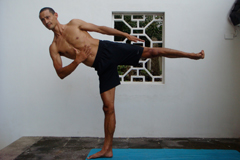
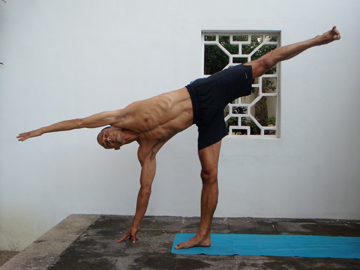
Where the half split and full split meridian stretches both used your body weight to lengthen your inner thighs, in half moon you use your outer hip muscles, the side gluteals, to open your inner thighs.
Incidentally, you may find that doing half moon pose after half split offers a nice relief to your hips.
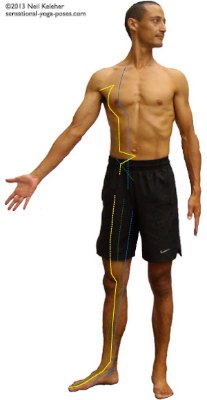
The usual version of half moon is to turn one foot out to the side, shift your weight on to that foot. Keeping your pelvis facing the front, lift your other leg. If you shift your weight towards the toes of your standing foot so that your toes press down you may find it easier to balance. You may also find it helpful to engage the outer gluteals of your standing leg.
If you are balancing with both hands off of the floor, try bending your spine upwards (picture 1 above.)
This will cause the abs on the upper side of your body to activate. You can then use the outer gluteals of your lifted leg to lift that leg higher and stretch the meridians of the inner thigh.
If you place one hand on the floor so that the hand and leg on the same side of the body are both on the floor, you may find it easier to lift your lifted leg higher.
If you keep the abs on the upper side of your body engaged, you may find that your lower back muscles on that side "release."
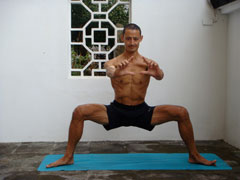
Wide Squat Yoga Pose
Wide squat or "horse stance" is another way of doing a meridian stretch for the inner thighs. Stand with your feet wide apart and your feet turned out.
Roll your shins out so that the outer edges of your feet press into the floor. Press the base of each big toe down into the floor.
Bend your knees. As you do so focus on relaxing your hip joints as you smoothly sink your pelvis down towards the floor. Press your knees back. As your pelvis sinks down reach your ribs up. You can reach your arms to the front and spread your shoulder blades if you like. You can also see how it feels to reach your arms out to the sides or up over your head. See how long you can stay in this pose. Also see how slowly you can come up.
As with half moon pose, I find that this pose can provide a nice "relief" to the hips after doing either the half split or full split meridian stretch.
Meridian Stretches for the Torso
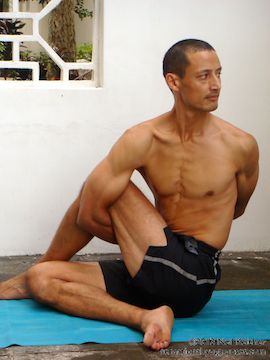
Meridian stretches for the torso can include back bending and forwards bending the spine as well as twisting it. I'll focus on two twisting poses, matsyandrasna and bharadvajrasana.
Ardha Matsyandrasana
To do ardha matsyendrasana, bring your left heel close to your right buttock and step your right foot over your left thigh.
(If you can't do this, try either straightening your bottom leg or placing your top leg foot to the inside of your bottom leg knee.)
Position your right foot close to your knee (as opposed to towards your hip.) Grab your right knee with your left hand or place your left elbow to the outside of your right thigh. In either case use your left arm to pull the left side of your ribcage forwards. With your right hand on the floor behind your use your right hand to pull the right side of your ribcage back.
Use your hip muscle to keep your pelvis facing the front.
You can imagine turning your pelvis slightly to the left as you turn your ribcage to the right.
Focus on feeling all of your ribs (you have 12 pairs) turning to the right. You can also focus on feeling all 12 of your thoracic vertebrae turning to the right. To do this, focus on one set of ribs or one vertebrae at a time, starting at the bottom of your ribcage and working your way up.
Bharadvajasana
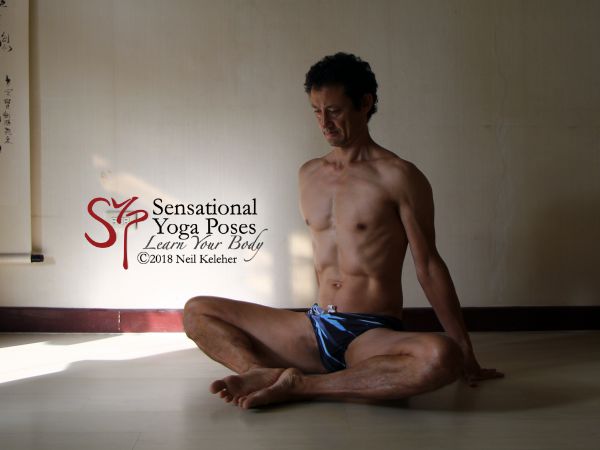
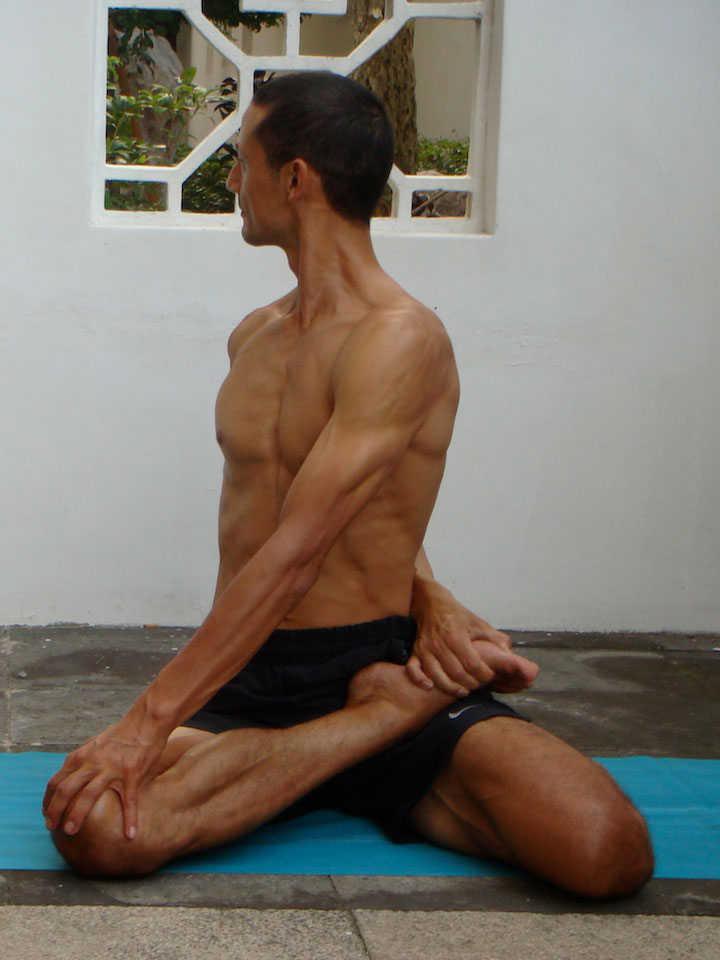
In Baradvajrasana, one leg is in hero position while the other leg is in lotus. You can then twist towards the side of your lotus leg.
If you can't do lotus then place your foot against your inner thigh instead (picture on the left.) If you can do lotus, then fold your left shin back, to the outside of your left thigh. Place your right foot on top of your left thigh close to the hip crease. Try to position your right heel close to the left side of your lower belly.
Reach your right hand forwards, and then reach it behind your back and grab on to your foot. Wrap a towel or strap around your foot and grab on to this if you need to.
Once you have a good grip on your foot, place your left hand on your right knee.
Try to flatten the inside edge of your right ankle. Make your right foot strong and use it as an anchor so that you can pull your right shoulder back.
If you right knee won't touch the floor, place a block beneath it and rest your knee on the block. In either case (with or without a block) press your left hand down onto your knee and lift your ribcage. Use both arms to twist and turn your ribcage.
Balancing Spleen, Liver and Kidney Meridian Stretches
You can Balance these inner thigh and torso stretches by stretching the side of the body.
Published: 2011 01 11
Updated: 2021 02 10